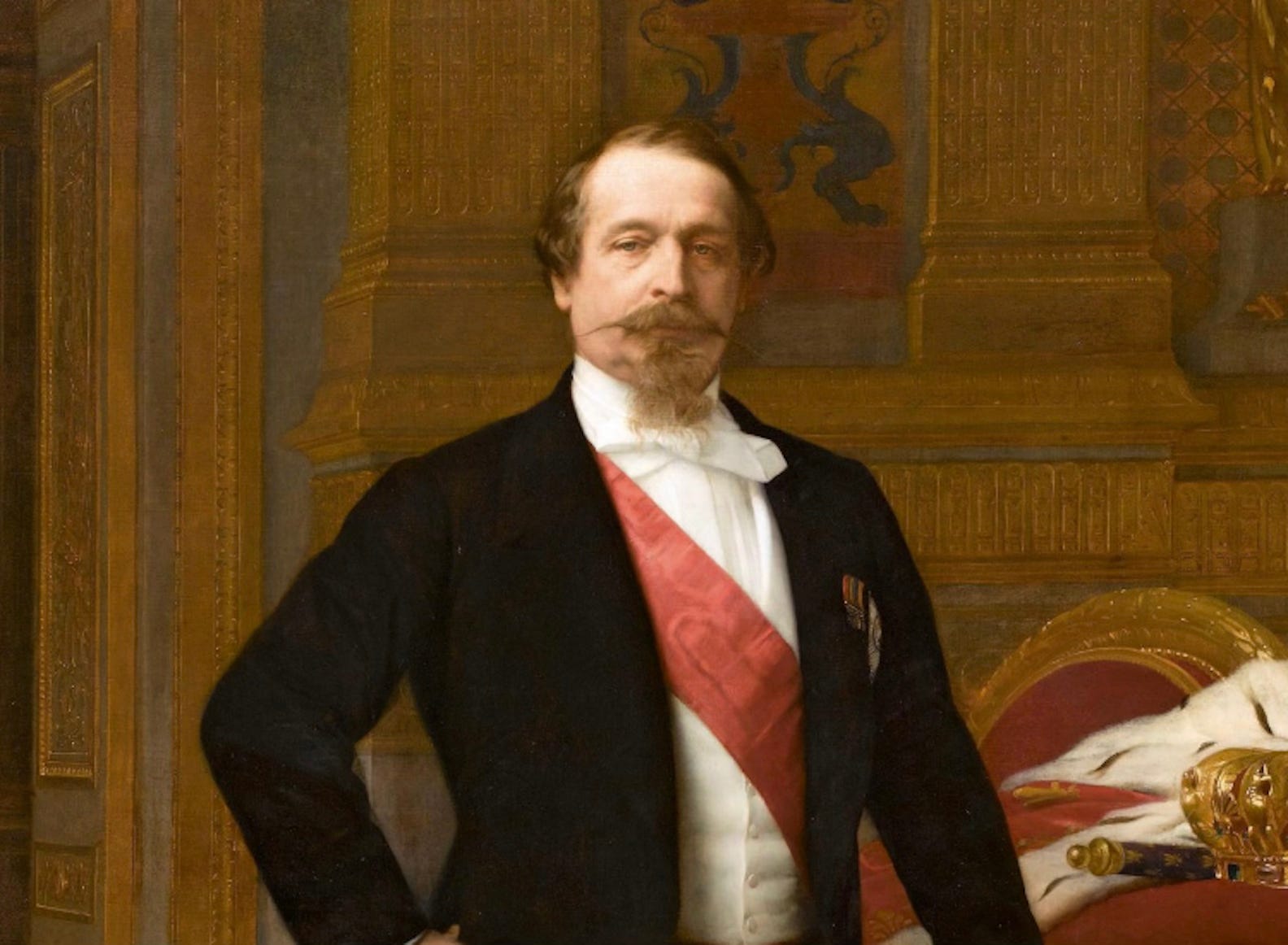
Is Trump Like Napoleon?
Yes, but not that Napoleon.
According to a new report in The Atlantic, Donald Trump thinks he’s one of history’s great conquerors—like Napoleon.
“He’s been talking recently about how he is the most powerful person to ever live,” a confidant said. “He wants to be remembered as the one who did things that other people couldn’t do, because of his sheer power and force of will.”
I hate to break it to Delusional Don, but unless insulting Europe on Truth Social is the same thing as conquering it, he’s no Napoleon.
But I do have a consolation prize for him—and, as the first-ever recipient of the FIFA Peace Prize, he clearly cherishes those. He’s a lot like history’s other Napoleon: the largely forgotten (for good reason) Napoleon III.
In 1840, King Louis Philippe of France ordered Napoleon I’s remains returned to Paris from the island of St. Helena, where the former emperor had spent his final years in exile. Louis hoped that importing this relic of France’s glorious past would boost his own sagging popularity, but instead it made the French realize how much cooler it would be to have a glamorous ruler like Napoleon rather than their dud of a king.
Eight years later, they got their wish: there was a third French revolution (after the first two in 1789 and 1830, they were getting pretty good at this). The French replaced their king with a legally elected president: Napoleon’s nephew, Charles-Louis Napoleon Bonaparte.
Voters who hoped this new Napoleon would usher in a long, magnificent period of French democracy might have been unaware of a trait he shared with Trump: a fondness for coups d’état.
He already had two coup attempts on his resume, in 1836 and 1840, both failed bids to overthrow Louis-Philippe. In 1851, he gave it another go, and the third time was the charm: he launched a coup against his own government, and, faster than you can say “Hang Mike Pence,” dissolved the French Assembly.
In addition to plotting coups, he shared another favorite pastime with Trump: mass deportations. He arrested thousands of political foes and dispatched them to remote penal colonies (Algeria was a favorite destination). To cement his new status as a brutal tyrant, in 1852 he crowned himself Emperor Napoleon III. (There had already been a Napoleon II: the original Napoleon bestowed that title on his son, who, in a cautionary tale for nepo babies everywhere, never ruled.)
In all the worst ways, Napoleon III’s reign, the Second Empire, resembled Trump’s Second Shitshow. There was rampant corruption, cronyism, and demolition that dwarfed the bulldozing of the East Wing: he mandated the destruction of 60 to 70 percent of the buildings in Paris.
Though modernization was the stated reason for this ambitious remodeling project, it also had a sinister objective. Widening Paris’s streets enabled Napoleon III’s troops to roam the city and shoot people, just in case the French were thinking of launching yet another revolution. (Trump might think that mowing down his own citizens was his brilliant innovation, but Napoleon III blazed the trail.)
The emperor was a role model for Trump in other ways. His prolific philandering infuriated his wife, Empress Eugenie, who rarely shared his bed. As for his personal aesthetic, he just couldn’t get enough gold, as this photo of his drawing room illustrates.
When it came to waging war, Napoleon III yearned to emulate the valor of his uncle, but wound up being more like Cadet Bone Spurs. The first Napoleon was a legendary soldier who relished riding his horse across a corpse-strewn battlefield. Napoleon III, like Trump, attended a military academy, but wasn’t much when it came to actual military service. During 1859’s Battle of Solferino, his attempt to cosplay as Napoleon I crumbled when he became so nauseated by the carnage that he vomited.
That queasiness didn’t stop him from plunging France into some truly idiotic wars—and this is where the parallels to America’s nappy-wearing Napoleon wannabe get ominous.
In 1862, he decided it would be a splendid idea to invade Mexico, a mere 5700 miles from France. At first, his mission seemed accomplished: he toppled the government of President Benito Juárez and installed Maximilian of Habsburg, Archduke of Austria, as Emperor of Mexico. But he apparently didn’t consider whether Mexicans would like being ruled by an Austrian prince. He got his answer in 1867, when they overthrew the hapless Habsburg and executed him by firing squad. The only Frenchman who emerged from this foreign fiasco ahead was the artist Edouard Manet, who got a famous painting out of the deal.
As ludicrous as Napoleon III’s Mexican misadventure was, the armed conflict that became his undoing—his Iran, if you will—was the Franco-Prussian War. When he declared war on Prussia in 1870—in part to distract from domestic woes—he was so confident of victory that he didn’t bother to enlist any allies. Less than two months later, the Prussian army took him prisoner in the Battle of Sedan, and the Second Empire collapsed.
Exiled to Britain, the ex-emperor dreamt of a comeback, but, like his cankled counterpart, he had health issues: bladder stones, chronic pain, and fatigue. Moving on from their decrepit leader, Bonapartists pinned their hopes on his son, Napoleon Eugene Louis Jean Joseph Bonaparte, The Prince Imperial. Like Don Jr., who has recently been mooted as the host of a possible reboot of “The Apprentice,” The Prince Imperial seemed—on paper, at least—to be his dad’s natural successor.
Alas, Napoleon III’s Mini-Me had something else in common with Don Jr. besides a famous last name: a near-total lack of charisma. When thousands of French journeyed to Britain for his eighteenth birthday celebration, his lackluster speech left them cold. Abandoning his ambition of becoming Napoleon IV, he joined the British army and shipped off to Africa, where, in 1879, he was fatally wounded by Zulu spears.
There’s one last thing about Napoleon III that should alarm Trump. The emperor may have demolished most of Paris and rebuilt it to his specifications, but today there is no major monument to him anywhere in the city. He represents a chapter of history that the French, for the most part, have chosen not to remember. You have to travel across the ocean, to New York’s Metropolitan Museum of Art, to find a small bust of him. It’s not prominently displayed and most visitors walk right past it.
TBR Question the Day: What historical figure does Trump most remind you of? Leave your answer in the comment section below:


So much good info in a small comedic article. The press could not do this-even without the humor! Thx Andy!
Caligula. Rotten in every way possible.